Jennifer Paquette of Laval, Québec, had stomach aches and diarrhea throughout elementary school. But she did not talk about it, even with her parents.
Only in 2009 when she was 15 did she speak up. Even then, she held back on the full story, she was embarrassed by all the going to the bathroom symptoms.
It reached a point where she could no longer hide the symptoms. She told her parents, and they took her to a hospital. Many questions and tests followed. She was diagnosed with Crohn’s and celiac disease. For the next ten years, she tried many medications and biologic drugs – nothing worked. Her Crohn’s was never fully under control.
Then, in 2020 at the age of 26, Jennifer had an intestinal blockage. A scan led to the shocking news that she had developed colon cancer, which the doctors thought was in its early stages. Before the surgery to remove the cancer, she was offered the possibility of an ostomy, a surgically created hole in her abdomen to allow stool to leave the body. She declined.
She says: “In my head, they’re for older people.”
“I didn’t think I could go swimming or take part in physical activities. I didn’t think I could live a normal life with an ostomy.”
During the operation, the doctors removed almost all of her large intestine. They were surprised to find that the cancer had spread outside the colon. It was stage 4 cancer. She had a 30 per cent chance of surviving five years.
The next months were one round of chemotherapy after another. Then in January 2021, Jennifer received the all clear, no more cancer.
In early 2023, her Crohn’s started acting up again. Her gastroenterologist suggested an ostomy. Again Jennifer refused.
In February 2023, she had a buildup of fluid in her abdomen and another intestinal blockage. More tests, but initially doctors did not think the cancer had returned. A biopsy in May 2023 showed that the cancer had indeed returned. Again, multiple rounds of chemotherapy.
Then, the worst day of her life. Cancer surgery for the second time. The cancer was also outside her intestines again. She needed to have her uterus removed, she lost the possibility of having children.
This time, there was no choice. She needed an ostomy. In retrospect, she feels it was the best thing that happened to her in all this ordeal.
She wonders if her opposition to having an ostomy led to additional inflammation and complications:
“If I had accepted it when I was 25, the doctors can’t say with 100% certainty that I wouldn’t be where I am today, but it would still have had an impact on the inflammation in my body. It would not have been as widespread.”
Unfortunately, in October 2024, the cancer came back for the third time. It is inoperable so she will continue to have chemotherapy for the rest of her life.
Today, she is happy to have an ostomy. Given what she knows now, she would have done it earlier. She also hopes her story will encourage other young people to consider it, rather than seeing it as something embarrassing.
She says: “My ostomy has given me freedom and removed the anxiety associated with numerous urgent trips to the bathroom. I don’t see myself without it now.”

Jennifer in 2024 before her cancer came back a third time
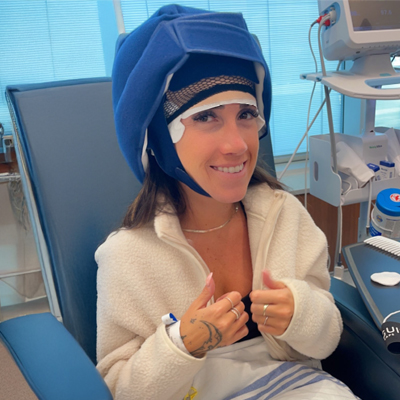
Jennifer in October 2024 receiving a chemotherapy treatment with a cooling hat
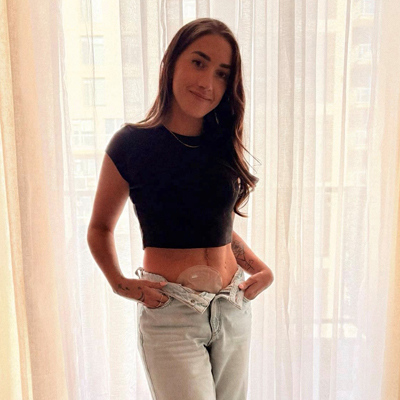
Jennifer in 2025 showing her ostomy